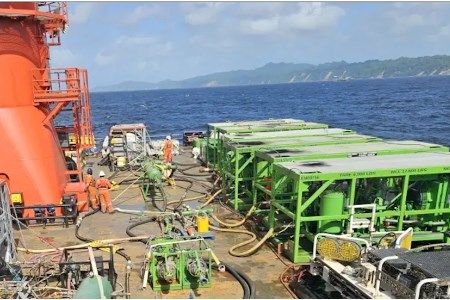
Activities to connect the Italian and Albanian coasts began in mid-January 2020, with pipes being welded and tested on board Castoro Sei and then laid onto the bottom of the Adriatic Sea in a continuous stretch, starting from the Italian shores towards Albania.
Health and safety come first. Therefore, considering the Covid-19 pandemic, TAP and its contractor Saipem implemented a wide range of stringent measures, aiming to protect the health and safety of all people involved.
Luca Schieppati, TAP Managing Director, said: “Completing the offshore pipeline section marks another key milestone towards the finalisation of our project. Once operational, TAP will bring a new source of natural gas to Europe, supporting decarbonisation, energy security and diversification. I am proud that these technically complex works have been conducted in line with the highest health and safety standards.”
John Haynes, TAP Project Director, added: “These are unprecedented times for all of us and the energy industry is engaged in a delicate balancing act: handling operations on the ground with extreme care, while continuing to provide the energy needed for our homes and businesses. The TAP project is now more than 95% complete and we look forward to crossing the finish line by the end of this year.”
Approximately 9000 pipes of 36-in. diameter have been used for TAP’s offshore section, weighing circa 100 000 t in total. The pipes have been laid on the Adriatic seabed: 25 km in Italian territorial waters, 43 km in international waters and 37 km in Albanian territorial waters.
The deepest point of the pipeline is approximately 810 m beneath sea level. Saipem’s Castoro Sei laid an average of 1.2 km pipes per day, reaching a peak of 2.8 km in a single day.